
Blind Prospect Theory
Kahneman and Tversky seem to have a quality problem

If you haven’t read Thinking Fast and Slow by Daniel Kahneman, you should. I also really enjoyed books by Richard Thaler, who likewise won a Nobel prize and even got a cameo in the movie The Big Short. With that said, I’ve long thought Prospect Theory has a blind spot. Literally.
The theory was created by really wonderful and careful research by psychologists Danny Kahneman and Amos Tversky in the 1960s and 1970s. Their life stories are truly fascinating, and deservedly featured in a Michael Lewis book The Undoing Project. However, if you have a skeptical eye, you can’t help but see that their experiments are based on somewhat flimsy hypothetical gambles. Tons of them. I tend to put a lot of stock in what Thaler calls “just asking questions.” However, there are traps, and making hypthetical choices involves some doozies.
For example, think about a variation of Sophie’s Choice. Would you be willing to sacrfice just one of your two children -or- flip a coin such that heads means both children survive but tails means both die? I don’t know which you would choose, but for me if it involved Naomi and one of her siblings then the choice is easy (Sorry Bomi). Just kidding! My point is that you may think, “Oh I would take the coin flip for sure.” But I don’t believe you. How people choose in theory is often, I believe, very different from how they behave in real life. I’ve seen it. Lots of brave guys in boxing practice freeze up in the ring, and lots of guys who think they will freeze up before parachuting were actually unfazed at altitude.
Real life is different than theory.
Turning back to prospect theory, the 1979 paper that started this behavioral revolution in economics used lots of these binary choices. The authors never said that one answer was correct, or that one was more rational. Rather, they noted that the tendency for people to choose risky options when monetary gains were offered reversed when the choices involved hypothetical losses. In table 1, below, four of the “loss” problems are summarized.
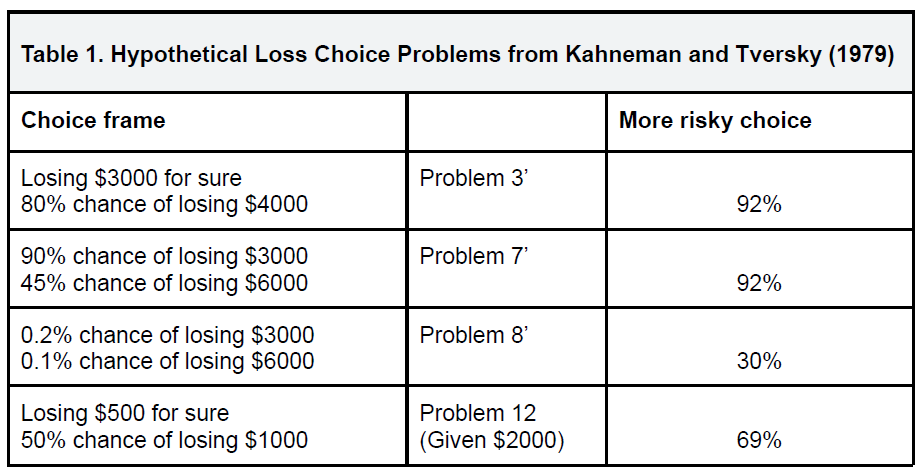
What Kahneman and Tversky said was irrational was the way people changed their risk preferences when it comes to losses. The sure gain of $3000 was preferred in problem 3, but the mirror loss choice in 3’ saw 92% of participants select the risk. And that’s, they say irrational.
I’m not saying the experiments were wrong. I am saying that I am not confident people would behave that with thier own real money in Vegas, for example. Besides, if people were really risk-seeking in the loss domain, then there’s a real-world counterfactual called the insurance industry.
I’m writing because I think there’s another problem with propsect theory that I call the “quality” problem. Sure enough, I’m not the first guy to think so. I discovered recently that some brilliant papers have been written along this line, notably by Johannes Müller-Trede, Shlomi Sher, and Craig R. M. McKenzie (at UC San Diego), and they make a really powerful case in a series of experiments that people tend to be risk-averse in the loss domain when it comes to gambling over real goods like bicycles and televisions. Losing a thing is a lot different, even in theory, than losing a number. They have been working on this for a decade or more, and although I wasn’t aware, they deserve credit.
What I did is something similar, with a wrinkle that the choice experiments I put together involve what I call endpoint losses. For example, Would you choose (a) a 50-50 gamble to be totally blind -or- (b) losing vision in only one eye for certain?
Here are results from my recent experiments:
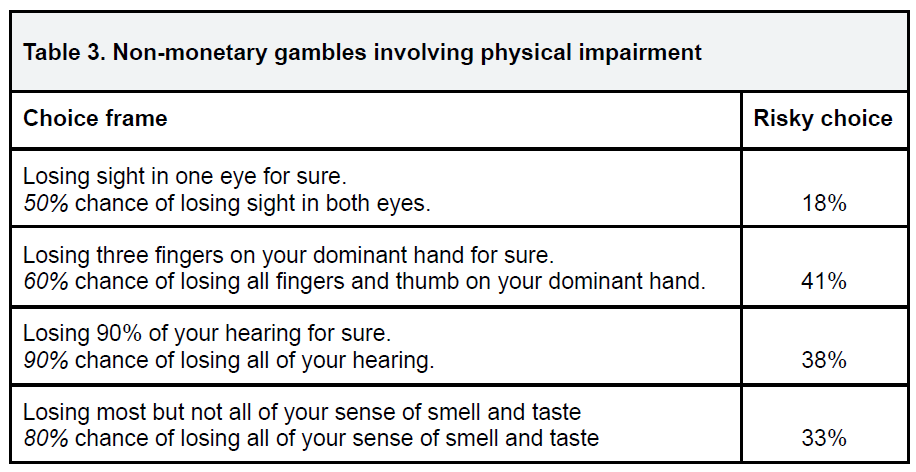
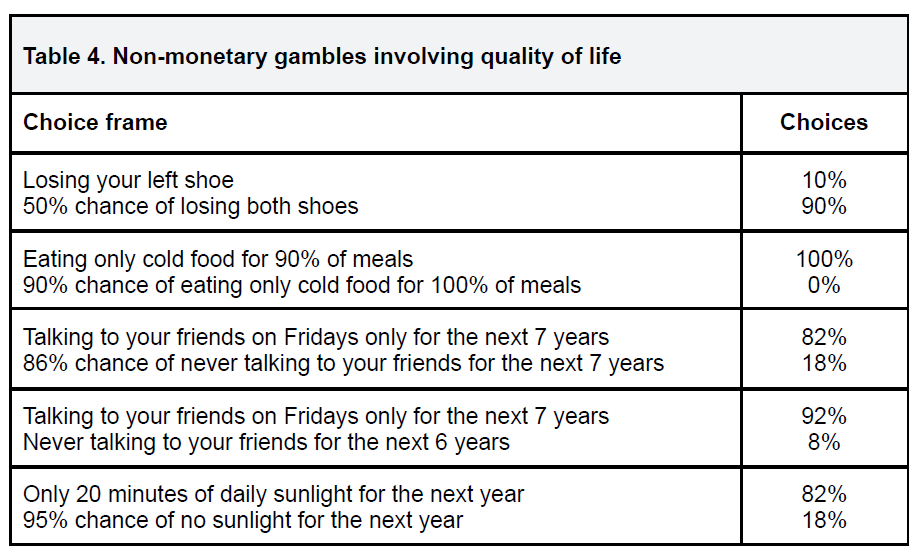
Do you see what I see?
Again and again, people are avoiding risk in the loss domain when it comes to qualitative stuff. The results seem awfully compelling, and I just tonight submitted a scholarly paper to a peer reviewed journal based on the above findings. Fingers crossed.
What does it all mean? Honestly, I don’t know. I haven’t thought through all the implications, though I do feel like old-fashioned utility theory deserves some love. There are more than a few nasty implications of the logic that people have diminishing sensitivity to losses, things like excessively high income taxes if each extra percentage hurts less than one before, authoritarian creep over your rights, and more. The nudgers seem to have developed a rather elitist assumption that people are sheeple because, in a nutshell, they believe that most voters aren’t rational (~smart enough to govern themselves).
I am tempted to call my paper, “Utility Theory Strikes Back” but I think the better title might be framing my side as the Jedi not the Sith, so how about, “The Return of the Utilitarians”?
—
The Books: